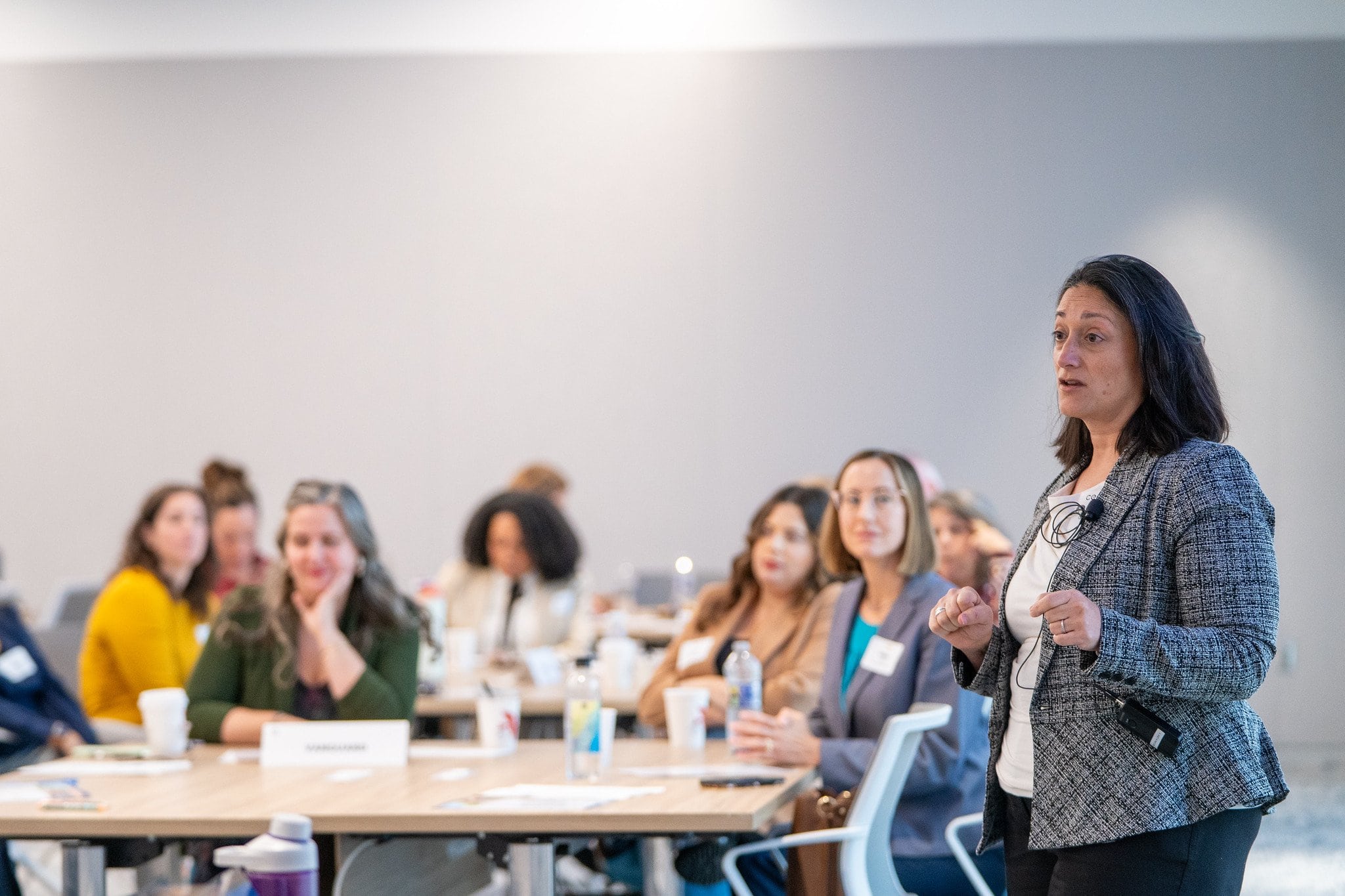
On September 30, social impact professionals and their colleagues from talent and HR teams gathered at Cencora in Conshohocken for Stronger Together: Aligning Social Impact & Talent for Business Success, an interactive workshop hosted by the Greater Philadelphia Corporate Volunteer Network (GPCVN). The session was built around the idea that corporate social impact is a business-critical talent driver, and the morning focused on a question many CSR teams hear from their companies: how can volunteer programs do more to build the skills employers need?
The facilitators, from BoardBridge and K.D. Moon Studio, started with the data. A Taproot Foundation report supported by PwC found that more than 70% of professionals surveyed said pro bono service strengthened their human skills, and respondents ranked experience-based learning, pro bono work included, ahead of traditional training for building skills such as problem solving and adaptability. As AI reshapes more jobs, the facilitators noted, most human-centered work remains hard to automate, which raises the value of programs that build those skills.
Stephe McMahon, co-founder and Chief BridgeBuilder of BoardBridge, which trains and places employees on nonprofit boards, said many of the CSR teams he works with are made up of one or two people supporting thousands of employees. Part of the goal for the morning, he told attendees, was “to give you all some space to step back a little bit and to think, what are the skills that you all are hoping to develop in your workforce?”
To make that concrete, attendees looked at the World Economic Forum’s list of skills employers see as core and discussed which ones nonprofit board service can develop. Jessie Heckman of Vanguard, who leads the company’s global employee engagement, pointed to resilience, flexibility and agility. A nonprofit board Jessie serves on, which provides housing services, faced a tight decision when a neighboring nonprofit partner serving Philadelphia youth was set to close. The board had roughly three months to decide whether to step in and what to take on. Working through a potential merger built the kind of resilient, agile thinking that is “not something that I would traditionally get in my day job,” Jessie said, and made room for “conversations, skills and a set of experiences that wouldn’t naturally happen in my career, however that experience continues to serve me today as I think about the type of agile mindset needed in this fast-paced environment.”
Krista Mondschein, founder of K.D. Moon Studio, then introduced the Impact Talent Compass, a maturity model designed to give CSR and talent teams a shared framework for putting volunteerism to better use. It covers eight dimensions across four levels: present, intentional, integrated and systemic. Participants scored their own organizations on two dimensions, measurement and ROI, and program design intent, then compared notes with partners and tablemates. Results went up on flip charts around the room.
Even common terms can trip teams up. “We use language differently, and sometimes we use the same words differently,” Krista told the group. “Employee engagement means something different for talent folks than it does for social impact folks.” To a social impact team, the phrase often means volunteer turnout and hours. To a talent team, it can mean satisfaction survey results.
Attendees also swapped ideas for opening that conversation with a talent team, especially when company priorities shift. Suggestions included mapping the talent lifecycle to find natural overlap and piloting an idea with a leader eager to try something new. One attendee described building a community volunteer component into a program for identified future leaders and tracking outcomes such as retention and promotions.
Aimée DiMichele-Donsky, Director of Talent Acquisition Operations at Children’s Hospital of Philadelphia (CHOP), spoke from the talent side. Skills are “a huge topic for us,” she said, and the idea of using volunteerism to help employees close skills gaps stood out. Her advice to CSR teams was to start from priorities the talent team has already set and ask “how does the work that you do intersect with that?” There are, she added, “pretty easy ways to incorporate that into the work that we’re already doing.”
Krista reminded the room that the morning was a starting point. “You’re beginning to have the conversations today,” she said. “You’re beginning to build the muscles today.” Attendees left with a completed assessment and a partner roadmap to take back to their organizations, whether they came with a colleague from talent or on their own.
The Chamber’s Greater Philadelphia Corporate Volunteer Network brings together CSR and community engagement leaders from member companies across the region to compare notes and coordinate volunteer opportunities. If your company is looking for more ways to get involved, learn more about GPCVN here.
To keep the conversation going, join us on November 10 at WHYY for Insights for Social Impact, an exclusive first look at the 2026 Civic 50 report and a celebration of this year’s honorees. Register here.