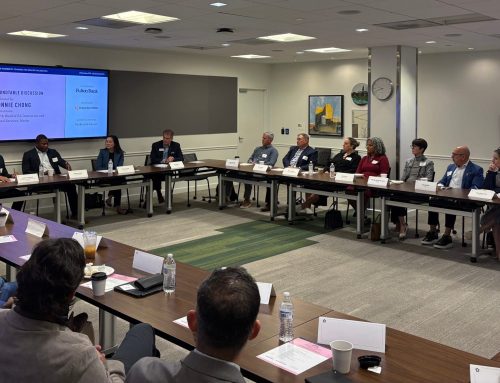

Chamber members gathered for an exclusive presentation and conversation with Senator Bob Mensch, the representative of Pennsylvania’s 24th district, including Berks, Bucks and Montgomery counties. The Senator shared details about new legislation aimed to create more transparency in economic development and tax policies and its potential impact on middle market companies (companies with revenues between $10M to $1B). Chamber members had the opportunity to get their questions answered by the Senator.
See below for a recap on the legislation Senator Mensch presented.
The Performance-Based Budgeting and Tax Credit Efficiency Act (Act 48 of 2017)
This legislation will require all departments and agencies to justify their budget requests beginning with dollar one. Beginning in 2019, each department’s budget will be analyzed for a year by agency heads and the independent fiscal office (IFO). Each budget will be discussed in a public forum and is open to the media and general public.
While it is an established practice in the private sector, there will be some adjustments to and through implementation of performance-based budgeting as it relates to governmental revenues. This process, the Senator said, is intended to grow over time and change to become more effective: to be evolutionary, not revolutionary.
“Performance-based budgeting is utilized to ensure that every dollar spent produces the desired result. I think that we should be doing the same with taxpayer dollars,” Mensch said. “This budgeting process will call on our legislators to make some tough decisions, but we have to stop increasing the size and scope of government operation without justification.”
Net Operating Loss (NOL) Carryforward
As NOL Carryforward continues to be a major concern for Pennsylvania’s growth economy, the Senator offered some insights into how the tax has become a detriment to our region.
“Net Operating Loss is an unfriendly tax for businesses, for which Pennsylvania is so notorious,” Mensch said. “It is a disincentive for businesses coming to Philadelphia.”
This bill helps to move the Commonwealth forward by enabling the creation of new jobs for Pennsylvanians and to help protect our existing jobs. Senator Mensch would ideally like to see a loss carryforward uncapped, resulting in reduction in tax liability. It is estimated the provision will create additional revenues of $80.3 million in 2018-19.
Qualified Manufacturing Innovation and Reinvestment Deduction
Also called the 21st Century Manufacturing Act, this legislation provides an incentive to Pennsylvania manufacturers to make large-scale investments to increase or establish manufacturing capacity within the Commonwealth. Qualifying businesses can deduct five percent of their capital investment from their corporate net income tax liability if they invest at least $100 million in building or refurbishing a manufacturing facility. “The goal is to provide PA manufacturers to make large scale investments to increase manufacturing capacity within the state,” Mensch claimed.
The qualm for some, however, was how this initiative would impact organizations of different sizes and classifications.
An attendee at the gathering spoke on behalf of non-profit organizations (NPOs) and small businesses to express the concern that this act provides no incentives for companies that cannot afford the $100 million investment required for the tax credits.
While incentives for NPOs led to a discussion around differing tax structures, the Senator was able to ease some worries for the time being.
“The intent behind these acts and bills is to improve the economy,” Mensch said. “Not to be punitive to any industry or sector.”
Opportunities to have significant discussions such as these with elected officials are frequently made available to members of the Chamber’s Action Teams including our Energy Action Team and Middle Market Action Team. For more information on the Chamber’s initiatives, visit ChamberPHL.com/Advocacy.